·
Behind the Scenes: Our Server Hardware & Performance
A deep dive into the hardware, infrastructure, and software that powers Vanilla Europa. From our Ryzen 9950X3D to Folia and enterprise DDoS protection.
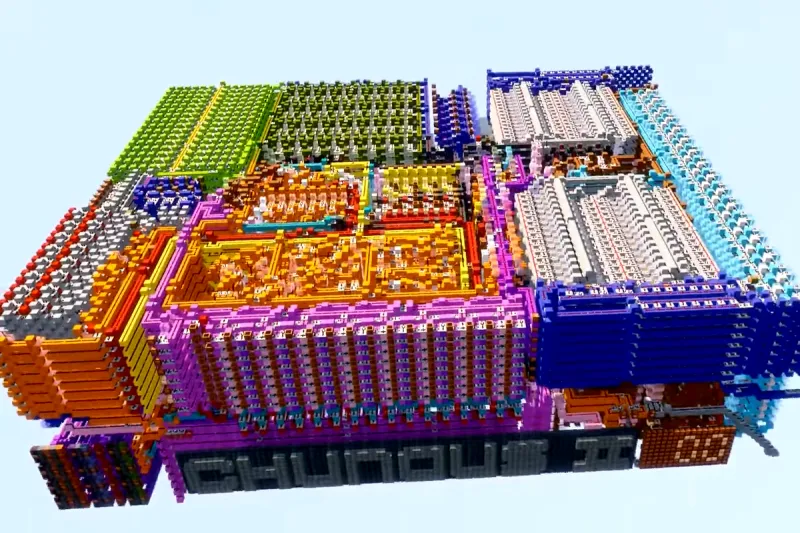
We often get asked what makes Vanilla Europa feel so smooth compared to other survival servers or how we have such high render distance. The answer is a combination of top-tier hardware, modern server software, and infrastructure decisions that prioritise player experience above all else. Here’s the full breakdown.
Hardware
Vanilla Europa runs on a dedicated machine hosted with Hetzner, one of Europe’s most reputable datacentre providers. The specs:
- CPU: AMD Ryzen 9 9950X3D. The flagship of AMD’s gaming-optimised lineup with 16 cores, 32 threads, and a massive 3D V-Cache, perfect for Minecraft’s demanding workloads.
- RAM: 128GB DDR5. More than enough headroom for the server and accompanying services running simultaneously.
We don’t use a shared VPS or a budget hosting panel. It’s a bare-metal dedicated Linux server that we manage ourselves.
Folia: The Game Changer
In January 2026, we migrated from Paper (a great software in its own right) to Folia, and the difference has been night and day. Ever since Folia released as a project, I had been preparing Vanilla Europa’s eventual move to it. Folia is a fork of Paper which adds regionalised multithreading to the server, essentially decoupling Minecraft from being a purely single-threaded process. This has had huge implications for server performance.
How Folia Works
If you’re curious about the broader topic of Minecraft server optimisation, this guide is a great overview of the kinds of trade-offs server owners have to make. Before Folia I practically had to learn this guide top-to-bottom to see how I could properly make the right compromises between server performance and player experience. Folia has changed the equation entirely.
Basically, before Folia, the entire server relied on a single thread. The server-ticking thread. That thread needed to process everything on the server (a tick) 20 times a second. If it was taking longer than a second to process 20 ticks, then players would start feeling the lag. To clarify, a thread is typically only processed by only one core at a time, meaning the server-ticking was essentially bound to a single-core. In the modern era, CPUs have multiple cores. Our Ryzen 9 9950X3D has 16 cores. What Folia does is split the world into regions, each with it’s own region-ticking thread. This means that the server has gone from everything being processed on one core to having that load spread between all the cores, resulting in improved performance and higher processing capacity. I hope this explanation leaves you as excited about Folia as I had been when we switched to it.
And this isn’t to say that Paper is a bad software because it relies on a single ticking-thread. It’s actually a great software and has been hugely influential in the Minecraft server space for creating more optimized server implementations. When you consider that the Paper jar itself is actually a heavily patched version of the base Minecraft server (which is very unoptimized), you see that they’ve actually improved a lot with what we have to work with. The single-threaded nature of the server is a byproduct of Minecraft originally being written according to older coding standards. And also, Folia is a fork of Paper, so there’d be no Folia without Paper.
Furthermore, when you consider that the multi-threaded Folia jar is a actually heavily modified version of the single-threaded vanilla Minecraft server jar, you realise how insane it is that they were able to pull this off while also preserving Minecraft’s gameplay mechanics. Even as someone who writes code, that seems like pure wizardry. Credits to SpottedLeaf for being the guy to lead this project. Before Folia, he was also behind many of the big optimisations for Paper.
Before Folia
Because of the single-threaded bottleneck, we had to make compromises to keep the server playable:
- Render distance capped at 5 chunks. Far below what singleplayer offers.
- Hoppers artificially slowed down. Transfer rates were throttled to reduce tick overhead.
- Mob spawn-rates reduced. All entities would be processed on the same thread, so at high playercounts, each player had to have less mobs spawn around them.
- TPS drops under load. During peak hours the server could chug and players would be able to feel it.
It worked, but it was a constant battle of trimming gameplay to fit within the limits of a single thread.
After Folia
With Folia, 16 cores, 32 threads, and 128GB of RAM available, we were finally able to lift the restrictions that had held us back for years. We did it cautiously over the weeks following the migration, raising limits gradually until we found a stable balance. The result:
- No TPS lag. The server holds a stable 20 TPS regardless of player count.
- High render distance. Players can see far into the world, just like singleplayer.
- Vanilla mob caps. No more artificially reduced mob spawning. Farms work as intended.
- Full hopper speeds. No more throttling. Redstone contraptions work properly.
- Lag machines nerfed by design. Since Folia isolates regions, a lag machine only affects the region it’s in rather than bringing down the entire server.
- Plenty of room to grow. We’re nowhere near the hardware’s limits, even during peak hours.
The goal has always been to give players a singleplayer-like experience in multiplayer — gameplay that isn’t hindered by the practical limits of traditional Minecraft SMPs. Folia has made that possible.
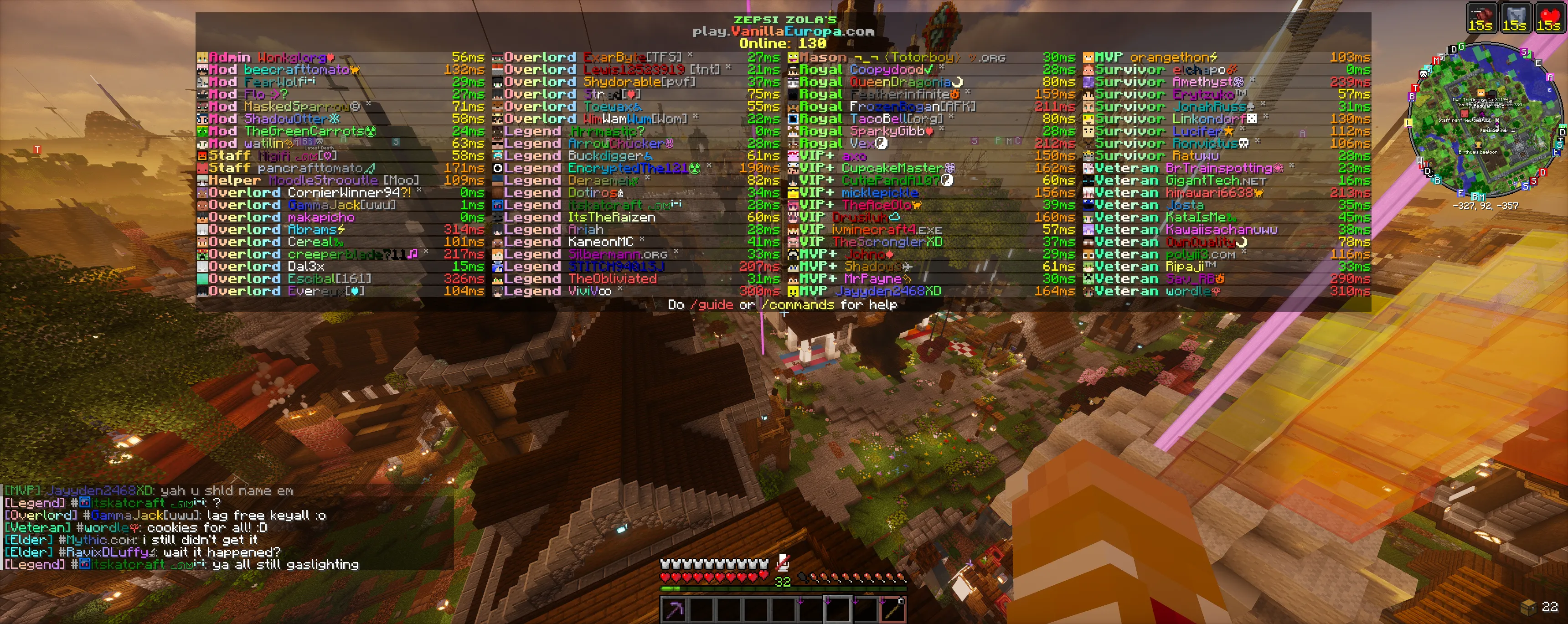
Network & DDoS Protection
Our server traffic is proxied through enterprise-level DDoS protection. Minecraft servers are frequent targets for attacks, and we’ve invested in proper mitigation so that an attack doesn’t mean downtime for everyone.
Despite being hosted in Europe, our network infrastructure delivers surprisingly good latency worldwide. Players regularly connect with comfortable ping from: United States, Canada, India, Taiwan, Singapore, Australia, New Zealand, South Africa, and everywhere in-between (except maybe Antarctica, North Korea, the International Space Station, and the Moon).
You don’t have to be European to enjoy Vanilla Europa.
Backups & Configuration Management
We take data integrity seriously:
- Daily off-site backups. Server files are backed up every day to a separate machine with a different hosting provider. If something catastrophic happens to the main server, your builds are safe. Uncompressed, our backups store over 7 TB of data.
- Git version-controlled configs. All server configurations are tracked with Git. Every change is documented, every tweak is reversible, and debugging becomes straightforward because we can see exactly what changed and when.
This might sound like a lot for a vanilla Minecraft server, but it’s exactly this level of care that lets us run confidently with zero map resets since 2018.
What This Means for You
When you join Vanilla Europa, you get a vanilla survival experience that feels like singleplayer (high render distance, proper mob spawning, no lag) but with hundreds of other players sharing the same world. No compromises, no gimmicks, just a Minecraft SMP server as it’s meant to be played.